Skip to content

Countering Repression That Follows People into Exile

Russia, Belarus, and other authoritarian regimes reach across borders to silence dissent.

Through our Center for Countering Transnational Repression, we leverage our expertise and networks to support people targeted in exile, document abuses, and work with policymakers in the United States and Europe to strengthen protections and hold those responsible to account

What is transnational repression?

Transnational repression occurs when a government reaches across borders, directly or through proxies, to intimidate, silence, or punish people abroad for actual or perceived dissent, criticism, or human rights work. It can target journalists, activists, and members of diaspora and exile communities, including by putting pressure on their families back home.

Hundreds of thousands of people left Russia and Belarus after 2022. Both governments extended their machinery of repression abroad through surveillance, intimidation, digital attacks, pressure on families, and the misuse of legal and administrative procedures.

  • Direct attacks

    Assault, abduction, physical intimidation and disappearance of people living abroad.

  • Using other countries

    Getting host states to detain or deport people, including through misuse of INTERPOL notices.

  • Mobility controls

    Cancelling passports or refusing consular services so people cannot travel or stay safe.

  • Threats from a distance

    Online harassment, spyware and surveillance, and pressure on family members back home.

Irina Babloyan speaking into a microphone
Opinion | Natalia Arno

When Dictators Cross Borders, Democracies Must Stand United

FRF’s president describes being targeted in exile and calls for a coordinated democratic response.

Read the op-ed

How we counter transnational repression

Protect people at risk

Through our Reforum community hubs in Berlin, Paris and Vilnius and our assistance in Warsaw, we offer legal advice and psychological support to pro-democracy actors and civil society in exile. The Center builds on this work so that people can find specialized help before threats escalate.

Document abuses and identify patterns

We draw on firsthand accounts, legal records, and open-source research to verify incidents and trace how campaigns unfold across borders. People who come to us for support decide whether to share their experiences for documentation.

Improve how governments respond

We brief policymakers in Washington and across Europe on our insights and deliver recommendations for how authorities can most effectively recognize, report, and respond to threats. That includes safeguards against the misuse of asylum and law enforcement procedures.

Pursue accountability

We work with legal partners to challenge abusive cross-border requests and prepare evidence that can support targeted sanctions or action by international human rights bodies.

Coordinate across borders

We bring together exile community organizations, lawyers, security specialists, and public officials to recognize early warning signals, improve referrals, and share what works when cases span several countries.

Why Free Russia Foundation

First-hand experience that shapes how we work

Free Russia Foundation was founded by Russian democrats in exile. For years, journalists, human rights defenders, and civic organizers from Russia and Belarus have come to Reforum for legal advice, counseling, and help rebuilding their lives. When a threat surfaces, they have somewhere they already know to turn.

Our experience with politically motivated prosecutions helps us recognize when a request for arrest or extradition abroad is part of a wider effort to silence someone. We bring the history behind those cases to officials and policymakers in Europe and Washington, where it can inform safeguards against the misuse of cross-border legal procedures.

Russian authorities designated the Foundation “undesirable” in 2019 and “extremist” in 2024. Staff and leadership have faced surveillance, cyber compromise, intimidation, poisoning incidents in Europe, and at least three assassination plots. This experience shapes how we safeguard sensitive information, assess the risks of making a case public, and why targeted communities extend us a degree of trust that formal institutions cannot easily earn.

The Center brings together trusted community access, direct casework at scale, and systematic documentation. We bring those findings to advocate with European institutions in Brussels and Strasbourg, and with governments in national capitals and Washington.

International advocacy

From recognition to protection

We press governments to turn international commitments into action plans and clear protocols for the institutions that respond when people are targeted abroad.

The European Parliament adopted its first resolution on transnational repression against human rights defenders in November 2025. In June 2026, it called for a coordinated EU response. The Parliamentary Assembly of the Council of Europe followed nine days later.

G7 leaders have issued their first statement on the practice, and the UN Human Rights Office has urged governments to protect defenders in exile. The report behind the June EU resolution estimated that some 3.5 million people are at risk.

OSCE | Warsaw

Countermeasures discussed at the OSCE conference

Irina Babloyan, FRF’s Director of Communications and a journalist, explained how Russia’s new “civil death” law can restrict access to consular services, banking and property rights for people targeted while living abroad. She urged governments to develop practical measures to protect those at risk.

Panel participants

Sviatlana Tsikhanouskaya, Leader of the Democratic Forces of Belarus, joined Silver Küngas, Estonia’s Human Rights Ambassador, Antonina Cherevko, Senior Adviser to the OSCE Representative on Freedom of the Media, and Vytis Jurkonis, Freedom House’s Director for Europe and Eurasia Programs. Marcus Kolga of Journalists for Human Rights moderated. Ambassador Ellen Svendsen, Norway’s Permanent Representative to the OSCE, delivered closing remarks.

Panelists at the OSCE Warsaw Human Dimension Conference
OSCE Warsaw Human Dimension Conference, 6 October 2026
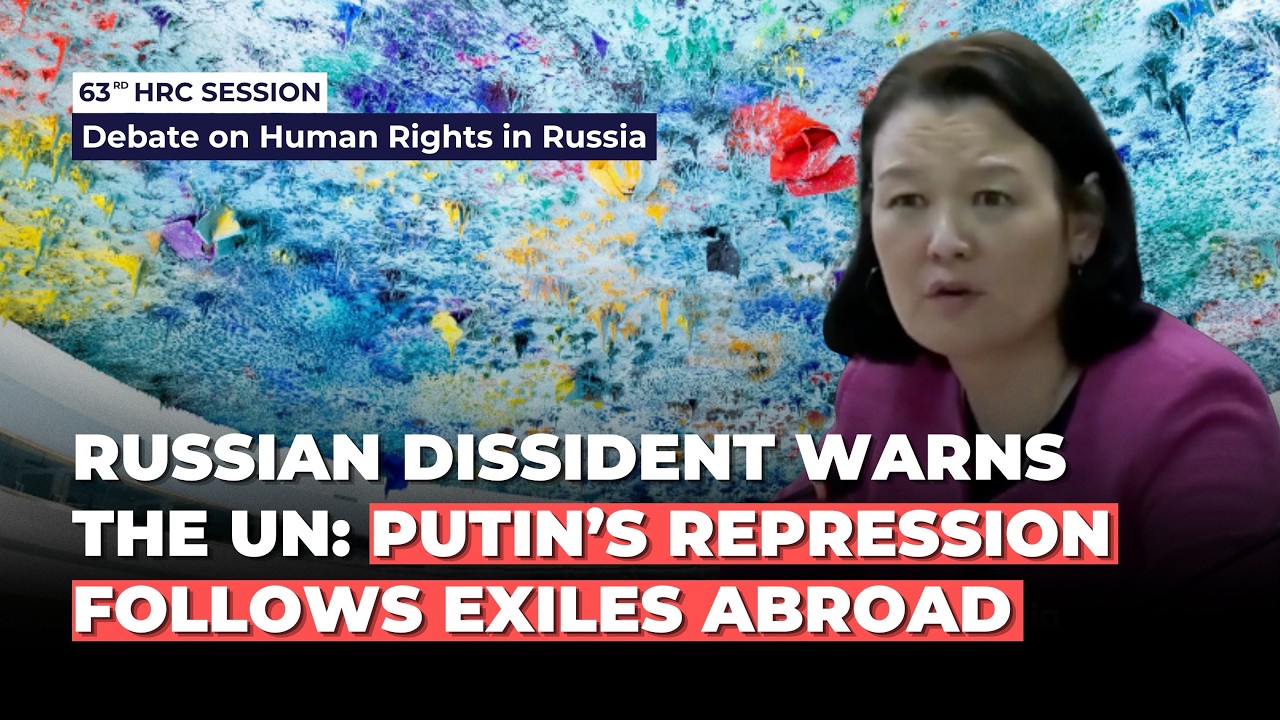
UN Human Rights Council | September 2026

Natalia Arno addresses the United Nations

Speaking at the invitation of UN Watch, FRF President Natalia Arno described the surveillance, intimidation and cyberattacks she faced in exile and recounted being poisoned in Europe. She called on democracies to confront transnational repression and protect people who have fled it.

Watch the speech or read the transcript
GLOBSEC Forum | Prague

Defending journalists and activists from transnational repression

At the GLOBSEC Forum, FRF’s Irina Babloyan argued that transnational repression is a European security issue. She linked attacks on journalists in exile to wider Russian hybrid threats, including drone incursions over European airports and sabotage of infrastructure. She urged European governments to treat protecting people targeted in exile as part of protecting their own security.

Panel participants

The discussion included Irina Babloyan, Saliou Babou of Global Affairs Canada, and Estonian investigative journalist Holger Roonemaa.

View the LinkedIn post
Photo from the GLOBSEC Forum session on transnational repression
GLOBSEC Forum, Prague, 22 May 2026
Direct assistance

Support for people at risk

14,000+legal and psychosocial consultations
10,000+people reached from 2024 to 2026

Through Reforum Spaces and Reforum Help, FRF supports people facing the legal, logistical and psychosocial consequences of displacement. Before Russia’s full-scale invasion of Ukraine, FRF was already helping evacuate human rights defenders and others at risk from Russia, Belarus and occupied parts of Ukraine to safer countries.

Today, FRF operates community hubs in Berlin, Paris and Vilnius and provides assistance in Warsaw.